"Inside the bag, as you now know, was the dress. A real Amsale silk taffeta wedding gown from the famed designer’s Blue Label. It was a gown so special with its ruched bodice, sweetheart neckline, and giant hand-made taffeta and organza flowers adorning the skirt that it even had its own name—the “Bijou”—which I’d loved because I’d minored in French, and as a Francophile loved all things French. And really, the second I’d seen the dress I’d known I didn’t give a shit about feminism.
...
Purchased new, Bijou retailed for $9000, but the consignment shop was selling her for a bargain $6000, and like the saleslady had said, they never got the Bijou on consignment and they’d just gotten her that morning and she’d surely be sold by the end of the day. And so I had walked out of the store with a cumbersome garment bag and six grand on my Visa card (my credit limit), despite not earning enough income to pay for the gown, despite not having a wedding date, despite not even having an engagement ring.​"
kali_vanbaale.png

​In Kali VanBaale's wonderful story "Bijou," recently published in Northwinds, the title character is both this wedding dress and the "stage name" of the narrator in the phone sex job she's taken to pay for said wedding dress. Not to give anything away, but the story is witty, a bit absurd, funny as hell, and subtly heartbreaking. I'm starting her novel The Space Between next month, and this has me primed and ready. (I just realized that last sentence made me sound a little like one of Bijou's customers.)

Posted
AuthorJohn Proctor

Alrighty, so the Ephemera section is now prettier, though still a bit sparse; I'll be collecting my random projects from the last 10-20 years (including - gasp - some juvenalia I recently found online) and putting them up there soon.​

​Also, I'm currently making sure I now have the rights to a couple of pieces, "The Transfiguration of Señor Gato" from New Madrid Journal of Contemporary Literatureand "Over and Under" from Imagination and Place: Weather - ​when I have that clarified, I'll post them online here.

I'll soon be dividing the Criticism section into music criticism and writing criticism, and adding all my reviews from Trouser Press and New York Cool to the music section. And I'll also be adding a Reportage section to the writing tab, and posting "journalistic" (whatever that means) pieces I've done on post-Katrina damage, blue crabs (of course), and the CUNY language immersion program where I used to teach.​

​And finally, my major website project for the summer is something called "The List and the Story," original web-only work which I'll be unveiling piece by piece very soon. O, the mystique!

Posted
AuthorJohn Proctor

There are simply so many good things to say about Lee Reilly's essay ​"The Relative Nature of Things" that the only thing I can think to do is to list them:

  1. ​It holds the double distinction of being a finalist in last year's mucho prestigioso Fourth Genre Michael Steinberg Essay Contest, and subsequently being published online in Hunger Mountain. (I had nothing to do with that, though I wish I did.)
  2. It's a list essay! Did I mention my well-documented love of the list essay?​
  3. ​Anyone who's had the pleasure/torture of sorting through their parents' old stuff can relate to the subject matter.
  4. It reminds me of Ewa Hryniewicz-Yarbrough's "Objects of Affection," one of my favorite essays from last year's Best American Essays (originally published in Ploughshares​). Both explore the relationship between family, objects and memory, exemplified in this passage from "The Relative Nature of Things": ​
    "Okay, I realize this argument is about more than things. It's how we perceive those things and value them. ​And even more than that: it's the meaning that is created as we three construct our own collections, as we choose the props of our own evolving narratives, as we toil, conscious curators of our own stories. For we've reached a turning point, an inescapable moment when this living archive that our parents kept intact for 60 years - these photos, scribbled drafts of sent letters, cookbooks, yearbooks, matchbooks, from places we've never been - will disappear, just as our parents have."
  5. ​​As a writer, Reilly has a style that makes me feel while reading it like I'm eating the darkest, richest chocolate truffle while sipping 30-year port. Timeless.


Posted
AuthorJohn Proctor

​I've been a big fan of Angela's work for roughly three years now, ever since I had the privilege of working with her in multiple workshops during graduate school. At its best, her writing is simultaneously gut-bustingly hilarious and so fiercely introspective it's about to make you cry.

​Which makes me that much happier to share her work that was recently published in Connotation Press. The first essay, "I Am Good at Eating," is perhaps my favorite piece of hers I've yet read, simply because it is so Angela Sparandera. It reads like both a confession and a manifesto, balancing passages like this:

​I keep telling myself that I can eat like everyone else. I begin the lie every morning, making an inner pact in my mind to not eat sugar and white flour today, or to only eat salad, or meal supplement bars, or to eat nothing. Maybe I can just work so hard I'll forget to eat lunch: "I only ate one very small breakfast, so I can definitely have this fourth dinner."

...with lines as killing as this:​

When I was younger I used to fantasize about cutting off all my fat. Just grabbing the knife that Mom uses to cut cantaloupe with from downstairs, and in the secrecy of my room, slowly slice each bump clear off...There was no blood in my fantasy. It was as though I were a plastic surgeon who defied all laws of nature...When I was done slicing off all the fat from my thighs to my neck, I would imagine my new body. Not all sliced up, but smooth and airbrushed. No recovery time at all.

To read Angela is to get to know her. She lets the reader into her fears, doubts, and (not least importantly) her Sedarisian sense of humor, leaving the reader better for having known her. And if you want to get to know her better, you can always visit her blog.

Posted
AuthorJohn Proctor

I just spent a couple of hours working on the design of the Personal Essays section, adding clickthrough photos and ​blurbs to make it a bit more visually, er, stimulating. I'll be doing this with the rest of the links to my work over the weekend. Enjoy, and let me know if there's anything you'd do differently!

Posted
AuthorJohn Proctor

​I've had the distinct pleasure of reading Jericho Parms' work in awe for three years now, and I'm thrilled to see her essay "A Chapter on Red" in Hotel America's Spring 2013 volume.

11-776x1024.jpg

Jericho does something I've seen few writers pull off: writing about art in a way that's neither arrogant nor stuffy. In fact, her writing - and this is what awes me - at its best manages to have both the elegance of fine crystal and the primal cut of a child's scream.

"A Chapter on Red" works in the tradition of Rothko, William Gass's On Being Blue​, ​and Joni Mitchell's Blue​ (to name but a few), stringing multiple images, stories, and observances along the trope of a single color. In one of these pearls, Parms remembers busting out her front teeth diving for a ball on the sidewalk in front of her home in the Bronx with her brother, and the days afterward:

My brother brought his friends by after school to show off, like a crime scene, the place where my face stained the sidewalk, which was little more than an inkblot, or splattering of paint. And yet, it recorded, like evidence, my first lesson in glory and pain, of how quickly we fall between the two, how humbled we become by our own missteps.

And as if that weren't enough, the new issue of Hotel Amerika​ also includes essays by auteurs Joe Bonomo and Chris Arthur. Read up!

Posted
AuthorJohn Proctor
"Can you imagine startin' here and getting to pitch for the championship of the World Series in New York City?...One thing makes a feller sad is knowin' that's behind, and what's wrong with him is nothing that giving back twenty years wouldn't cure. 'Cept they don't do that, do they?"

These are the words of my great-uncle Preacher Roe,  who pitched for the Brooklyn Dodgers after growing up in Ozark country, then moved back to those hills to live out much of the rest of his life. This quote comes from The Boys of Summer , which I'm currently plowing through on the recommendation of my friend Matthew Goodman, whom I've thoroughly regaled with stories of the Ozarks, my Kansas youth, and the obsession with New York City - Brooklyn in particular - that brought me to the greatest borough on earth.

I've been thinking quite a lot lately about Preacher, whom I never knew but my Uncle Jim shared letters with late in Preach's life until his death in 2008, which I mention in my piece "I Was Young When I Left Home." Last Christmas, Uncle Jim gave me one of Preach's old gloves; I never played baseball myself, and in fact I was petrified of being hit by baseballs anytime I was near a diamond (okay, I still am), but I like to put that old glove on every once in awhile now and imagine his life.

I also mention another great-uncle in "I Was Young," my grandmother's brother Ollie, who was also from Arkansas Ozark country but never achieved much fame, dying somewhere in France in 1944 after being drafted during World War II. I keep thinking of Preach's words above, spoken when he was 55 years old, and then thinking of my Uncle Ollie, who was 19 years old when he died. They both came from Arkansas hill country. One died young enough that I can say without reservation that he hardly lived; the other lived to be old enough to regret growing old. One achieved a fame bordering on immortality in sports history in a city that welcomed him; the other died violently, alone and unknown in a land he didn't know. Both seem, to me at least, tragic.

Posted
AuthorJohn Proctor

​Managed to fire up the grill both nights this weekend and once last weekend, with what will surely be three summer staples in the Proctor household (except of course the fiddleheads, which will soon be gone with the cherry blossoms):

Monkfish kebabs​

Monkfish kebabs

Tilefish silver dollars, with fiddlehead ferns

Tilefish silver dollars, with fiddlehead ferns

Brats!​

Brats!​

Posted
AuthorJohn Proctor
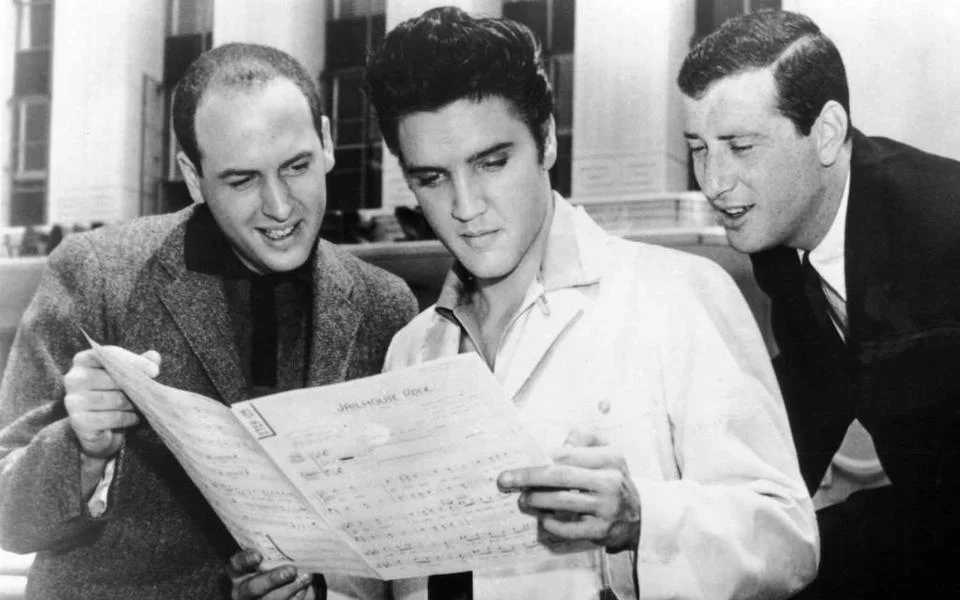
Mike and Jerry, with some guy from Tupelo

Mike and Jerry, with some guy from Tupelo

I just saw last night that Allmusic.com posted a playlist of their favorite Leiber/Stoller songs, which reminded me of how much I love the duo. I would in fact say they're my favorite popular songwriting team of all time. I didn't say they're the greatest - who am I to say? - but they are my favorite, and it's not even really close. "You Ain't Nothin' But a Hound Dog," "Yakety Yak," even "Stuck in the Middle with You" are all so indelibly part of our cultural lexicon that I can't imagine a world without them.

But as great as these songs are, they're just that: great pop songs. ​Jerry Leiber and Mike Stoller only once - to my knowledge, at least - ventured into a realm of narrative creation that transcended genre, transcended music, transcended time even: the magisterial "Is That All There Is?," made popular in the version sung/spoken by Peggy Lee.

I actually first heard the song as performed by Polly Jean Harvey from her album Dance Hall at Louse Point​; this version is, in fact, to me the definitive one. The song's structure of various Important Life Events - one's house burning down, going to the circus, falling in love, dying - rendered in spoken deadpan with the jovially existential refrain, "Is That all there is, Is that all there is? If that's all there is, my friends, then let's keep dancing..." are equally perfect for PJ Harvey and for Peggy Lee, and for the countless wandering souls, myself included, who have found refuge for decades in its not-quite-despair.

​It shouldn't be surprising that Jerry Leiber found his inspiration for the song in a short story, Thomas Mann's "Disillusionment." The narrator of the brief tale meets a curious stranger at the Piazza di San Marco in Venice and listens to him relate many of the same Important Life Events, marveling at the man's eccentricity. Leiber eliminated the middle man, relating the bitter disappointment of each MLE failing to meet up to her/his expectations in the first person and adding the wonderfully fuck-it-all refrain, and a song was born.

Recently Ivan Santiago-Mercado wrote a fairly comprehensive overview of the song's genesis for The Peggy Lee Bio-Discography and Videography (how's that for a clunky title?), which you can find here. But more importantly you should listen to the song, again and again, or for the first time.

Posted
AuthorJohn Proctor
2 CommentsPost a comment

I'm coming off a weeklong binge on freshman writing the likes of which I only have to deal with once a year: 60 12-page essays in 7 days. I'm realizing now, looking back at my Facebook posts over the last few days, I'm realizing tat I'm pretty funny when I'm frustrated.

Posted
AuthorJohn Proctor

Last night, stepping out from our friends' apartment into a cool, calm spring evening, my almost-four-year-old daughter had a concerned look on her face.

"I can hear the birds singing," she said.

"I know," I replied. "It's nice, huh?"

"But I can't hear anyone talking." Here she grew even more pensive, and stopped walking. "It needs to be NOISY."

Good lord, we've raised a city kid.

Posted
AuthorJohn Proctor